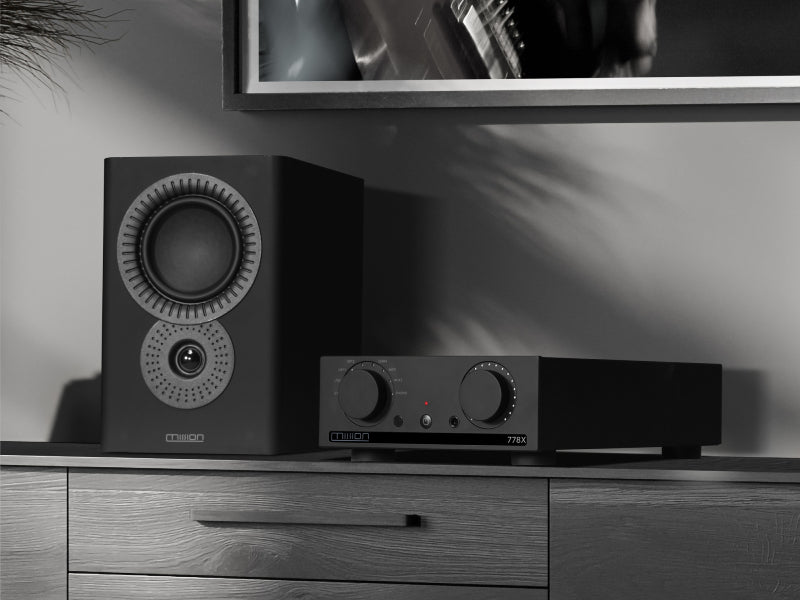
The Mission 778X (2022) integrated amplifier is a nod to Mission's original 778 launched way back in 1983. The 778X has much in common with the original, a compact, half-width design that delivers a sound that belies its diminutive footprint. Like the original the Mission 778x sports a useful range of inputs, its circuitry has been entirely redesigned to meet and exceed contemporary standards, the new amp is a great sonic match for Mission’s current range, just as the 778 was in its day.
The Mission 778X ’s all round performance is engaging, detailed and refined. Detail, timing and dynamics excel, regardless of source or medium. Designed for the modern-day music enthusiast with a nod to our heritage, the Mission 778X does not discriminate when it comes to expression and enjoyment of your music reproduction.
Perfect for Turntables
The phono stage is based around a JFET-based circuit with precise RIAA equalisation. It’s optimised for MM cartridges and as such, it’s a high-quality, low-noise input that eliminates any need for an additional phono pre-amp.
Bluetooth wireless connection
Complementing the typical RCA line inputs are digital and coax connection options and a built-in Bluetooth receiver with an aptX and AAC codec, meaning the 778X offers CD performance via Bluetooth wireless connection. The convenience of streaming music from smart devices, such as phones, tablets or PCs have never sounded so good!
High-performance DAC
That’s not all in terms of digital music facilitation. The 778X is also equipped with a high-performance ESS ES9018K2M Reference chip with ESS Technology’s 32-bit HyperStream architecture and Time Domain Jitter Eliminator. In the world of digital music files, this means the 778X offers class-leading, ultra-low noise digital audio file compatibility, with a sampling rate of up to 384kHz (PCM) and DSD256!
Headphone Amplifier
Equal in performance to standalone headphone amplifiers, beyond the price- class of this complete system, the design offers high-speed output signal transition thanks to a high slew rate. The result is a dynamic, detailed and engaging performance with all manner of headphone types.
Revisited as a sister model to the eagerly anticipated reintroduction of the Mission 770 – a model which heralded the return to UK manufacturing for the Mission brand; the Mission 700 takes what was referred to as an ‘industry benchmark, in the original 700 model, but utilises Mission’s 45 years of evolution and development in loudspeaker design.

Led by Mission’s Director of Acoustic Design, Peter Comeau, the Mission 700 bears a striking aesthetic resemblance to the original. However, there are many complex innovations and improvements that bring this revered model bang up to date.
Emphasis on Design
As with the flagship 770, Mission has developed a polypropylene bass/midrange driver and model-specific motor system. This transducer not only upgrades the loudspeaker’s integral design to take account of modern power handling and dynamic requirements, but it also maintains the extended response and low colouration of the original model with all the hallmarks and distinction of a class-leading loudspeaker. From the rigid, cast chassis to low-density surround, every aspect has been revisited to offer a driver with improved rigidity and precision-controlled cone-termination for dynamic performances and offer tight, fast, energetic output.
The distinctive reflex port has been carefully profiled both internally and externally to achieve very low distortion and extension to below 38Hz in-room – quite an achievement from a cabinet of this size!
Employing a lightweight, coated microfibre dome for the high-frequency driver, the Mission 700 replicates the flagship 770 with a specially damped rear chamber that offers super smooth treble performance, largely thanks to the resonance control offered by such a design.
Inverted Driver Geometry
The Mission 700 was a precursor for what would become a Mission standard in an unconventional driver array, something Mission refers to as ‘Inverted Driver Geometry’. Not just a design statement, IDG is a staple of Misson loudspeaker design from the 700 onwards. By positioning the treble unit below the bass/midrange driver, the length of the path is equalised so the sound waves coincide at the listener’s head height. This principle improves ‘time alignment’. Such design requires more than just inverting the speaker cabinet. Every aspect of the industrial and mechanical design requires a precision calculation to ensure the positioning, spacing and alignment aids the objective of optimum ‘time alignment’. This is perfected by an artisan-level crossover design.
The Crossover
Part of the Mission design process includes advanced software-based crossover mapping and simulation to accurately equalise the balance of the drivers for seamless integration into the overall loudspeaker performance. Not breaking with tradition or protocol, the efficiency of the software-based development is matched in equal part with 1000s of hours of listening tests. The resulting crossover design brings a musical character with thrilling detail and musicality not just matching but superseding the acclaimed level of performance set by the original Mission 700.

As it was in the beginning with the original, the Mission 700 packs technology and know-how into a benchmark loudspeaker design that is never short in bass definition, frequency response; lack of colouration; imaging; transient attack; depth and perspective; accuracy and linearity; speed and dynamic range. And as you’d expect from a model with such nostalgia and history, the emotion in the musical performance is never short in supply!
The Cabinet
Form factor remains true to the original, wherever possible. This includes hand-applied, rich rose-tinted walnut or black real wood veneers and a luxurious laminated white-front baffle. However, as spoken of in the original design, the Mission 700 makes use of less visible innovations incorporated into the design. The 700 cabinet uses a sandwich construction of differing woods bonded by a layer of damping adhesive. Internal bracing adds further strength and support while a mixture of foam and long hair fibre provides internal resonance and reflection absorption.
Mission 700 Stands
Perfected to a fraction of a millimetre, the Mission 700 Stand is precision manufactured.
The base plate and structure are perfectly stable and offer critical damping from unwanted vibrations, ensuring you hear the Mission 700 perform as it was intended!
Specifications
| Model: |
778X |
| General Description: |
Digital-to-Analogue Converter, Stereo Amplifier |
| Design Philosophy and Core Technology: |
• Integrated Amplifier (45 watts @8 ohms, 65 watts @4 ohms)
• ESS Sabre32 ES9018K2M Reference Chip
• Ultra-low Noise Digital Audio File Compability (384kHz PCM, DSD256) • Bluetooth 5.0 (aptX / AAC) Support
• Dedicated High-performance, Low-noise MM Phono Stage
• Headphone AMP With High-speed Output Signal Transition
• USB Upgrade Support
• Large Tractile Controls With LED Level Indicators |
| Inputs: |
1 x Coaxial, 2 x Toslink Optical, 1 x PC USB, 1 x Bluetooth (aptX/AAC),
2 x AUX,1 x RCA (Phono MM) |
| Outputs: |
1 x Coaxial, 1 x Toslink Optical, 1 x RCA (PRE Out) |
| Sampling Frequency: |
Optical / Coaxial: 44.1kHz-192kHz;
PC USB:44.1kHz-384kHz(PCM) / DSD64, DSD128, DSD256 |
| Preamplifier Section: |
|
| Gain: (max.) |
+0dB (Line), +47dB (Phono MM) |
| Input Sensitivity: |
540mV (Line, Volume = 0dB); 2.5mV (Phone MM, Volume = 0dB) |
| Input Impedance: |
10K (AUX); 47K//100pF (Phono MM) |
| Total Harmonic Distortion: (THD) |
<0.003% |
| Frequency Response: (ref. 1kHz) |
20Hz-20kHz (±0.1dB) |
| PRE Output Level: |
2.1Vrms (max.) |
| PRE Output SNR: |
>110dB (A-weighted) |
| DAC: |
|
| D to A Converter: |
ESS Sabre32 ES9018K2M |
| Resolution: |
32-bit |
| Max. Sampling Frequency: |
Optical/Coaxial: 192kHz; |
|
USB: PCM 384kHz / 11.2896MHz (DSD256) |
| Total Harmonic Distortion: (THD) |
< 0.001% (1KHz @ 0dBFS) |
| Output level: (0dBFS, 1KHz) |
2.1Vrms |
| Power Amplifier Section: |
|
| Gain: |
+31dB |
| Rated Power Output: |
2x45W(@8ohms); 2 x 65W (@ 4 ohms) |
| Frequency Response: (ref. 1kHz) |
20Hz-20KHz (± 0.5dB) |
| Total Harmonic Distortion: (THD) |
<0.005% (30W / 8 ohms) |
| Input Sensitivity: |
540mV (RCA AUX In); 2.5mV (Phono MM) |
| Signal-to-Noise Ratio: (SNR) |
>108dB (ref. 45W, A-weighted) |
| Crosstalk @1K: |
>80dB (ref.1W) |
| Standby Power Consumption: |
<0.5W |
| Headphone Amplifier: |
|
| Total Harmonic Distortion: (THD) |
< 0.01% (1kHz, 50mW ) |
| Output Impedance: |
4.7 ohms |
| Load impedance: |
20-600 ohms |
| General: |
|
| Dimensions: (mm) (W x H x D) |
236x98x380.6 |
| Carton Size: (mm) ( W X H X D) |
450x392x175 |
| Net Weight: |
6.3kg |
| Finish: |
Black / Silver |
| Power requirements: (depending on region) |
220-240V ~ 50/60Hz; 100-120V ~ 50/60Hz |
700 Bookshelf Speaker Specifications
| General Description: |
2-way vented-box / standmount |
| Enclosure Type: |
Bass reflex |
| Transducer Complement: |
2-way |
| Bass Driver: |
6.5-inch (165 mm) mineral-loaded polypropylene cone |
| Treble Driver: |
1.25-inch (28 mm) soft dome |
| Sensitivity (2.83 V @ 1 m): |
86 dB |
| Recommended Amplifier Power: |
25–150 W |
| Peak SPL: |
106 dB |
| Nominal Impedance: |
8 Ω |
| Minimum Impedance: |
5.2 Ω |
| Frequency Response (±3 dB): |
45 Hz – 20 kHz |
| Bass Extension (-6 dB): |
38 Hz |
| Crossover Frequency: |
3.0 kHz |
| Cabinet Volume (Litres): |
24.8 L |
| Height (On Plinth): |
510 mm |
| Width: |
260 mm |
| Depth (With Terminals): |
(270 + 22) mm |
| Carton Size: |
680 × 410 × 630 mm |
| Net Weight: |
12.8 kg per speaker |
700 Stand Specifications
| Columns: |
High carbon steel with internal damping |
| Top plate: |
High carbon steel |
| Base frame: |
Interlocked high carbon steel tube |
| Base spikes: |
Hardened stainless steel |
| Dimensions (mm): |
|
| Height (on spikes): |
485 mm |
| Width: |
320 mm |
| Depth: |
330 mm |
| Top plate (W × D): |
260 × 270 mm |
| Carton size: |
740 × 410 × 130 mm |
| Net weight: |
6.5 kg/pc |
| Gross weight: |
14.6 kg/ctn |